RED DEER REAL ESTATE APRIL 2026: WHAT'S ACTUALLY HAPPENING IN CENTRAL ALBERTA
By Amanda Blake | #1 Listing Sales Agent in Central Alberta - 9 consecutive years | 1,700+ homes sold | Lime Green Realty Central | April 2026
This is not a declining market. It is a more precise one. The gap between homes that sell in days and homes that sit for weeks comes down almost entirely to one thing: pricing strategy in the first week on market.
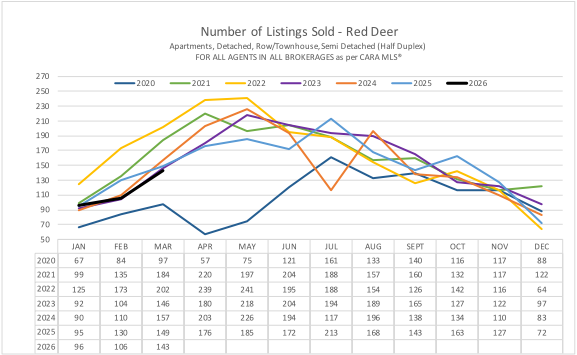
The Red Deer real estate market in April 2026 is not slowing down, but it is changing. If you are thinking about buying or selling in Red Deer, Sylvan Lake, Blackfalds, Lacombe, or anywhere in Central Alberta, understanding what is actually happening in today's housing market is the difference between a strong outcome and a frustrating one.
What I'm seeing every day is a clear pattern: buyer demand hasn't disappeared, but it has become more deliberate. The homes that are capturing that demand are doing so decisively. The ones that aren't are sitting, and wondering why.
Here is what the data shows, and what nine years of listing experience in Central Alberta tells me it actually means.
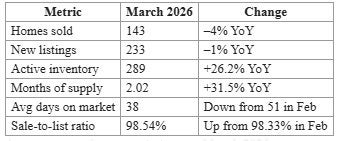
RED DEER MARKET STATS - MARCH 2026 Source: Alberta Real Estate Association / Pillar 9, City of Red Deer Monthly Statistics
Average prices by property type — March 2026:

On paper, this reads as a healthy, seller-leaning market, and it is. Two months of supply, a 98.54% sale-to-list ratio, and falling days on market are not the markers of a declining market. The modest year-over-year price dip on detached homes - down 1.6% - is not a freefall. It is the market finding a more sustainable level after several years of rapid appreciation. What those headline numbers don't show is where the market is dividing, and why that division matters most right now.
WHAT THE NUMBERS MISS: HOW THE MARKET IS ACTUALLY SPLITTING
Not all inventory is new inventory
Active listings are up 26.2% year over year. That looks like increased opportunity for buyers, but a meaningful portion of that increase is not fresh listings. It is homes that were listed earlier this year, didn't sell, and are now back on market with new photos or minor adjustments at similar price points.
Buyers notice this. A re-listed home carries a perception of risk, it raises the question of why it didn't sell the first time. In a market where buyers are well-researched and deliberate, that stigma creates a steeper climb than the raw inventory number suggests. More listings does not automatically mean more competition for buyers. It means more competition between sellers.
Pricing precision is the single biggest variable
The 98.54% sale-to-list ratio sounds like a broad market trend. It is not. That number is being carried almost entirely by correctly priced homes. Look at homes that required price reductions and you see a very different picture: longer days on market, fewer offers, and eventual sales below what would have been achieved with accurate pricing from day one.
The first five to seven days on market are now the most critical window in a listing. That is when a home receives its highest organic visibility, in email alerts, search feeds, and agent recommendations. If the price creates hesitation in that window, buyers move on. They don't typically come back.
If a home is getting showings but no offers, the market is giving you feedback, and it is almost always price or positioning.
Spring activity will not fix a pricing problem
This is the most common misconception I am hearing from sellers right now. The thinking goes: more spring buyers means more tolerance for ambitious pricing. That is not how today's buyers operate.
Spring creates more activity. It does not create less-informed buyers. Buyers in Red Deer and Central Alberta in 2026 have access to recent comparable sales data. They know what sold last month and for how much. An overpriced listing in a busy spring market does not attract spring buyers, it gets passed over by them while correctly priced competition absorbs the demand.
More buyers doesn't fix an overpriced home, it exposes it faster.
WHAT MOST AGENTS WON'T SAY ABOUT THIS MARKET
The biggest misconception right now is that rising inventory signals a weakening market. That is not what we are seeing. More listings are creating more competition between sellers, not fewer buyers. Buyers are becoming more selective, not disappearing. And pricing mistakes are being exposed faster than they were even six months ago, because buyers have more to compare against and less urgency to overlook a red flag.
The Central Alberta real estate market in 2026 did not slow down. It got more precise. And in a precise market, strategy matters more than timing.
PRICE RANGE BREAKDOWN — RED DEER, MARCH 2026
Under $300K (apartments, entry-level) - Slowing. Apartment sales down 18% YoY. Price appreciation of +17.2% shows demand exists, but volume is shrinking as rate sensitivity bites.
$300K–$499K (rows, semi-detached, entry detached) - Most active. Highest sales concentration per AREA price range data. Fastest absorption. Correctly priced homes in this band are still moving in the first week.
$500K–$599K (mid-range detached) - Active. Solid demand, particularly for turnkey homes. The detached average of $515,434 sits in this band. Presentation and condition are now differentiators.
$600K–$799K (move-up and premium detached) - Balanced. Longer timelines. Buyers negotiating harder. Conditional offers more common. Overpriced homes in this range are sitting.
$800K+ (luxury and acreage) - Patient market. Thin buyer pool. Economic uncertainty is pausing discretionary decisions. Sellers need realistic pricing and exceptional positioning.
THE SUB-MARKET STORY MOST PEOPLE ARE MISSING
Treating Central Alberta as a single uniform market is one of the most expensive mistakes a buyer or seller can make. Conditions vary significantly by community, and the right strategy in one area can be the wrong strategy two towns over.
Blackfalds is the standout story of the past 12 months. Average detached prices jumped from $403,000 to $490,000 year over year — a single-year appreciation of $87,000. With Red Deer's detached average now at $515,434, buyers comparing the two are asking real questions about value per dollar. Sellers in Red Deer need to be pricing with this cross-community competition in mind.
Lacombe and Lacombe County are outperforming, sales volume and pricing both running above last year.
Innisfail and Ponoka continue to favour sellers, with lower inventory and fewer competing listings.
Clearwater County currently favours buyers, wider selection and real room to negotiate.
Your strategy should be built around your specific community and price point. General Central Alberta market headlines are not a substitute for a property-specific analysis.
ECONOMIC CONTEXT SHAPING BUYER BEHAVIOUR
The Bank of Canada held its policy rate at 2.25% on March 18, 2026, with the next announcement on April 29. Most major bank forecasts , CIBC, RBC, BMO, Capital Economics, project no rate changes through the remainder of 2026, with the prime rate sitting at 4.45%. We are near the bottom of this rate cycle, but meaningful cuts are not on the near-term horizon.
The larger source of buyer hesitation is not the rate itself, it is uncertainty around US tariffs and the CUSMA trade review scheduled to conclude in July. Canadian GDP contracted 0.6% in Q4 2025 and national unemployment reached 6.7% in February 2026. Even in a market with real affordability advantages, that macro noise creates pause in buying decisions.
Alberta, however, is outperforming the national picture significantly. Provincial GDP growth is forecast near 2.6% versus 1.1% nationally. Job growth sits at 2.8% above the national average. Red Deer had the highest regional employment growth in Alberta in 2024 at 6.4%. And interprovincial migration, particularly from Ontario and British Columbia, continues to drive housing demand in Central Alberta in a way the national numbers don't capture.
WHY BUYERS ARE STILL CHOOSING CENTRAL ALBERTA
The affordability advantage is real and it remains large. Red Deer's total residential average sits at $415,227. The Calgary benchmark sits above $700,000. For buyers leaving Ontario or British Columbia, the gap is even more significant, they are trading congestion, cost, and commute pressure for space, recreational access, and a pace of life that is genuinely different.
Sylvan Lake real estate continues to attract families and lifestyle-driven buyers. Lacombe and Blackfalds are drawing buyers who want proximity to Red Deer's services at lower price points. Remote and hybrid work has made the Calgary-Edmonton corridor a viable primary location for buyers who a few years ago would have needed to be in a major centre.
WHAT THIS MEANS IF YOU ARE SELLING
The opportunity is real. Two months of supply, a 98.54% sale-to-list ratio, and 143 sales in a single month are not the hallmarks of a struggling market. But the conditions require more precision than sellers could get away with in 2023 and 2024.
Price correctly from day one. The first week on market determines more about your outcome than any other single factor. A home that enters at the right price and captures the organic attention window will consistently outperform a home that starts high and reduces — even when the eventual asking prices are similar. Buyers who watched a price drop are negotiating from a different psychological position than buyers competing in the first week.
Presentation and marketing are not optional differentiators right now, they are baseline requirements. With active inventory up 26% year over year, buyers have more to compare. The homes that stand out on both strategy and presentation are capturing the demand. The ones that don't are sitting.
WHAT THIS MEANS IF YOU ARE BUYING
This is the most selection buyers have had in Central Alberta in two to three years. The $600,000 and above segment in particular offers real room to negotiate, something that was nearly impossible at the height of the market. Well-priced homes in the $300,000 to $500,000 core range are still moving quickly, so preparation matters. But the frantic, conditions-free, over-asking environment of 2023 is not what you are walking into.
Buyers waiting for rates to drop further before entering the market are taking on a different kind of risk. Most forecasters see the Bank of Canada holding at 2.25% for the balance of 2026, with a small chance of a rate increase rather than a cut. Every month of waiting has a real cost, rent paid, appreciation missed, and the risk of more competition if economic confidence returns in the second half of the year.
Thinking about selling or buying in Red Deer, Sylvan Lake, Blackfalds, Lacombe, or surrounding Central Alberta communities?
I have been the #1 listing sales agent in Central Alberta for nine consecutive years, with over 1,700 homes sold and a 98% sale-to-list ratio. If you are thinking about selling, or want a clear picture of what your home would sell for in today's market, reach out. I'll walk you through exactly how to position it properly from day one.
#1 Listing Sales Agent in Central Alberta
Broker/Owner
Lime Green Realty® Central
Lime Green Realty® Central is a licensed user of the Lime Green Realty® trademark. Lime Green Realty® is owned by Lime Green Realty Franchising Inc.
 The data included in this display is deemed reliable, but is not guaranteed to be accurate by the Central Alberta REALTORS® Association. The Real Estate listing information and related content displayed on this site is provided exclusively for consumers. personal, non-commercial use and, may not be used for any purpose other than to identify prospective properties consumers may be interested in purchasing. This information and related content is deemed reliable but is not guaranteed accurate.